
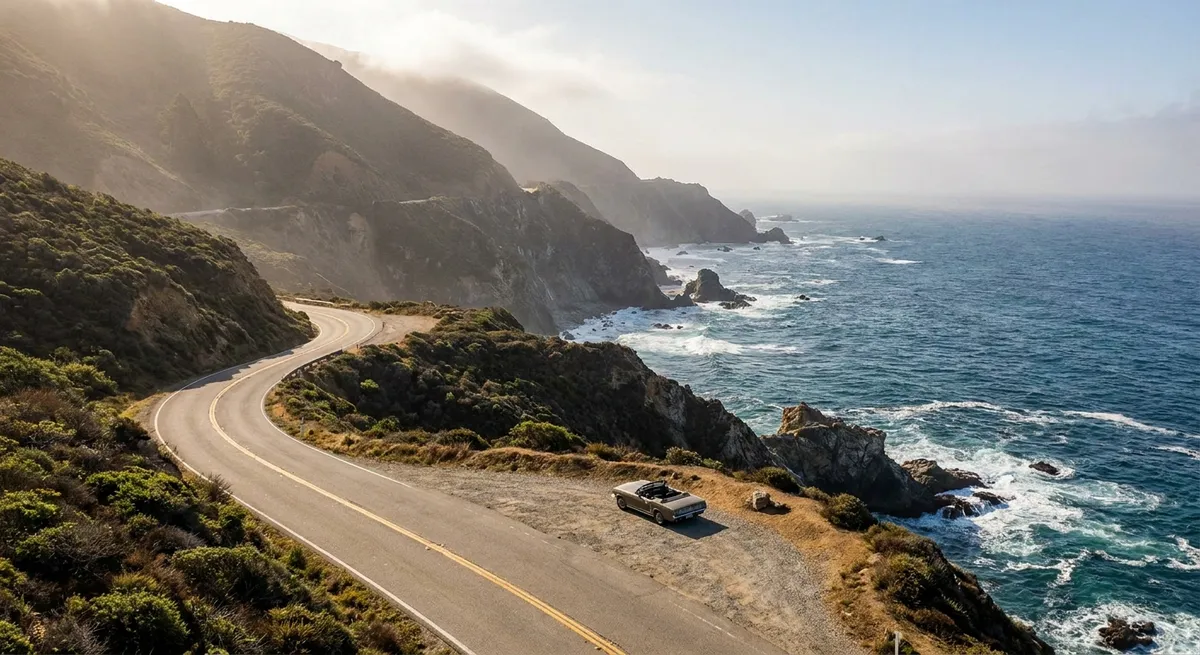
Big Sur isn't a town — it's a dramatic stretch of coastline where cliffs tower over the Pacific and the road has no guardrails. Here's why people call it the most beautiful coast in America, and where to actually stop to see it.
Defining America's Most Scenic Drive
Big Sur is not a city or a town with defined borders; it is a rugged and untamed region. This roughly 90-to-100-mile stretch of central California coastline, framed by the Santa Lucia Mountains and the Pacific Ocean, is widely regarded as one of the world's most breathtaking drives. It represents a dramatic confluence of land and sea, where redwood groves meet crashing waves and narrow roads cling precariously to cliff faces.
The experience is defined by its wildness. Unlike more developed coastal areas, Big Sur has resisted large-scale commercialization, leaving vast expanses of raw, protected nature. For travelers, especially those in the 35-64 demographic seeking immersive natural experiences, this region offers a powerful escape from urban life.
The Engineering Marvel of Highway 1
The journey itself is the main attraction, made possible by State Route 1. The highway is an engineering feat, carved into sheer cliffs and spanning deep canyons. Reports from travelers often highlight the thrilling, and at times unnerving, nature of the drive, with its tight hairpin turns, steep drop-offs, and sections completely lacking guardrails, offering unfiltered, heart-stopping views of the ocean below.
Construction of the highway was a monumental undertaking in the early 20th century, connecting the isolated communities of the region. Today, it serves as the primary artery for exploring Big Sur's treasures, demanding a driver's full attention while rewarding them with unparalleled coastal scenery at every turn.
Iconic Vistas and Essential Stops
While the entire drive is scenic, several key landmarks are considered essential stops. The Bixby Creek Bridge is arguably the most famous, an elegant concrete arch soaring 260 feet above a steep canyon. It has become a symbol of Big Sur and a mandatory photo opportunity for visitors.
Further south, Julia Pfeiffer Burns State Park is home to McWay Falls, a rare 80-foot "tidefall" that cascades directly from a granite cliff onto the sandy cove below. Other notable stops include Pfeiffer Beach, known for its purple-hued sand and dramatic Keyhole Rock arch, and the various turnouts (vista points) that offer safe places to pull over and absorb the immense scale of the landscape.
Beyond the Turnouts: Exploring the Wilderness
Big Sur's appeal extends far beyond the pavement. The region is home to several state parks, including Pfeiffer Big Sur State Park and Andrew Molera State Park, which offer extensive networks of hiking trails. These paths lead visitors away from the road and into serene redwood forests, across coastal bluffs, and down to secluded beaches.
This inland wilderness provides a stark contrast to the exposed, windswept coastline. In the canyons, ancient redwood trees create a tranquil, shaded canopy, and the Big Sur River offers opportunities for quiet contemplation. Exploring these areas reveals the true ecological diversity of the region, far from the crowds at the main vista points.
The Fragile Coast: Challenges and Conservation
The dramatic beauty of Big Sur is a direct result of its volatile geology, which also presents significant challenges. The Santa Lucia Mountains are prone to landslides, especially after heavy rains, which can lead to extended closures of Highway 1, sometimes isolating the community for months. The road is in a constant state of repair and reinforcement.
This fragility underscores the importance of responsible tourism. Conservation efforts are paramount to preserving the region's delicate ecosystem. Visitors are strongly encouraged to practice Leave No Trace principles, stay on marked trails, and respect wildlife to ensure the pristine character of Big Sur endures for future generations.
Navigating Your Journey: Practical Considerations
A trip to Big Sur requires planning, as services are limited and often spaced far apart. Reports consistently advise travelers to fill their gas tanks before entering the region, as fuel stations are few and expensive. Similarly, cellular service is virtually nonexistent along most of the drive, making it a true digital detox.
Accommodations, ranging from rustic campgrounds to luxury inns, often book up months in advance, particularly during the peak season from late spring to early fall. For investors and professionals accustomed to constant connectivity, this forced disconnection can be a core part of the appeal, but it necessitates preparation, such as downloading maps for offline use.
The Enduring Allure of a Wild Coast
Big Sur's legacy is one of raw, elemental beauty that has inspired artists, writers, and thinkers for generations. It remains a place where the power of nature is on full display, largely untouched by the modern world. The drive is more than a simple road trip; it is an immersive experience that challenges and inspires.
As travelers continue to seek authentic and transformative journeys, Big Sur's combination of thrilling roads, majestic scenery, and profound tranquility ensures its place as a bucket-list destination. It stands as a testament to the value of preserving wild places in an increasingly developed world.