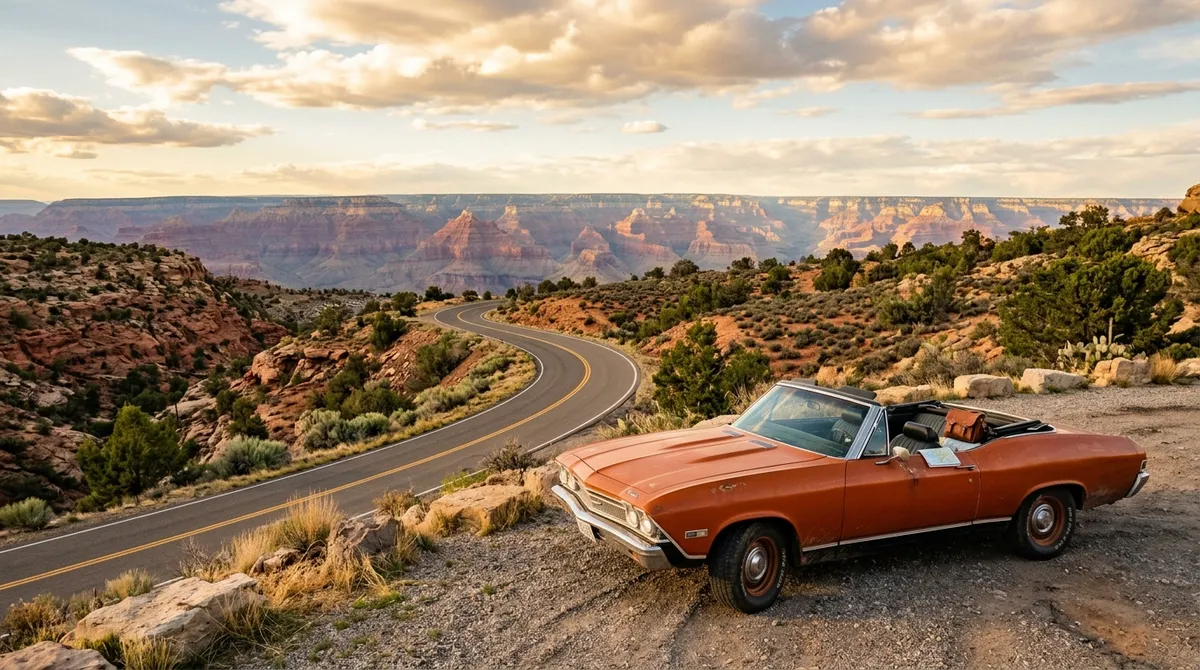
Technically, Route 66 doesn't go to the Grand Canyon.
The road skirts it by about 60 miles to the south, running through Williams, Arizona instead. But every Route 66 traveler takes the detour, and so should you. The Grand Canyon is one of the seven natural wonders of the world, and you'll never be closer than you are when you hit Williams. Spending half a day or more here costs you a few hours of road time and gives you an experience that genuinely belongs on a "before you die" list.
Here's how to fit it in efficiently.
Williams — The Gateway
Williams, Arizona is the official Route 66 town for the Grand Canyon — it's where the spur road north (Highway 64) begins, and it's one of the best-preserved Route 66 towns on the route. The downtown is two blocks of original motels, diners, saloons, and shops, all leaning into the Route 66 / Wild West aesthetic without feeling like a theme park.
If you're going to the Canyon, stay overnight in Williams the night before. Hit the Canyon early the next morning (it's a 1-hour drive), spend the day there, and either come back to Williams that night or drive on to Seligman.
Where to sleep in Williams:
- The Grand Canyon Railway Hotel. Modern and comfortable, attached to the historic railway depot.
- Canyon Motel & RV Park. Vintage motel rooms plus original railroad cabooses you can sleep in.
- The Lodge on Route 66. Old-school motor lodge, central, well-priced.
The Grand Canyon Railway (Optional but Iconic)
A quirky option: take the Grand Canyon Railway instead of driving. A 65-mile vintage train ride from Williams to the South Rim, with on-board entertainment (yes, including a fake train robbery), bar service, and a 3-hour stop at the rim before the return trip. It takes the full day but eliminates the parking nightmare at the Canyon. Not cheap, but unique.
If you're driving, skip this and go via car.
Driving to the South Rim
The drive from Williams to the South Rim is 60 miles north on Highway 64, takes about an hour, and is itself beautiful — high desert, ponderosa pines, occasional views opening up. The road ends at the Grand Canyon Village, where you'll park and explore on foot or by shuttle.
Park entrance fee: $35 per vehicle, valid 7 days. An "America the Beautiful" annual pass works.
What to Actually Do at the South Rim
The South Rim has 13 miles of accessible rim and dozens of viewpoints. Don't try to see them all. Here's the high-value short list:
Mather Point. First viewpoint you hit, right next to the visitor center. Crowded but the view is spectacular.
Yavapai Point and Geology Museum. Best educational stop — the museum explains how the Canyon formed, and Yavapai has one of the widest, deepest views of the inner gorge.
Bright Angel Trailhead. If you want to walk into the Canyon, this is where you start. Do not attempt to hike to the bottom and back in one day — people die doing this every year. But walking down to the 1.5-mile rest house (about 1,000 feet of descent) and back up is doable in 2–3 hours and gives you a completely different experience than the rim views.
Hermit Road shuttle. A free shuttle bus runs west from Grand Canyon Village along Hermit Road, hitting 9 viewpoints over 7 miles. The road is closed to private cars in summer. Hopi Point and Pima Point are the best sunset stops.
Watchtower at Desert View. The eastern entrance to the park, 25 miles from the main village. The Desert View Watchtower is a 70-foot stone tower designed by Mary Colter in 1932, with hand-painted interior murals and the best easternmost views of the Canyon. Worth the drive even if it's your only stop.
Time at the Rim — How Long Is Enough?
Minimum: 4 hours. Park, see 3-4 viewpoints, eat lunch, photos, drive out. This gives you a taste.
Better: a full day. Add the Hermit Road shuttle and a short walk down the Bright Angel Trail.
Best: overnight. Stay in the park or in nearby Tusayan and catch both sunset and sunrise. Sunrise at the Canyon is the unanimous favorite — cold, quiet, and the light comes up the walls in stages over 30 minutes.
Where to Sleep at the Canyon
Inside the park: El Tovar Hotel (the historic 1905 lodge) is the dream stay. Books out 6–12 months in advance for summer. Bright Angel Lodge is the more affordable in-park option.
Outside the park (Tusayan, 1 mile from the entrance): The Grand Hotel or Best Western Premier Grand Canyon Squire Inn. Standard, clean, easy.
If you've planned ahead, sleep in the park. If you haven't, sleep in Williams or Tusayan and drive in.
Practical Tips
Mornings beat afternoons. Parking lots fill up by mid-morning in summer. The visitor center lot is full most days by 10am. Be there by 8am if you can.
Bring layers. The South Rim sits at 7,000 feet. It's 20+ degrees cooler than Phoenix or Las Vegas. Even in July, sunrise is in the 40s. In winter it snows.
Don't underestimate the sun. Above-rim or below-rim, the sun is intense. Sunscreen, hat, water — non-negotiable.
Free shuttle buses are your friend. The park has an excellent free shuttle system. Park once, ride the buses, don't try to drive between viewpoints.
Cell service is spotty inside the park. Download your maps and offline guides before entering.
Don't skip the Hopi House. Right next to El Tovar Hotel. Designed by Mary Colter in 1905 to look like a Hopi pueblo, it sells authentic Native American crafts. One of the best museum-quality shops in any national park.
When to Skip the Detour
The only reasonable case for skipping the Grand Canyon is if you've been there before and you're in a hurry. Otherwise, take the half-day. The road will still be there tomorrow.
Back to the Pillar
The Grand Canyon detour is stop seven of ten. See the full route here: Most People Drive Route 66 Wrong. These Are the 10 Stops That Matter.
Next stop: Seligman, Arizona — the spiritual capital of the Mother Road.