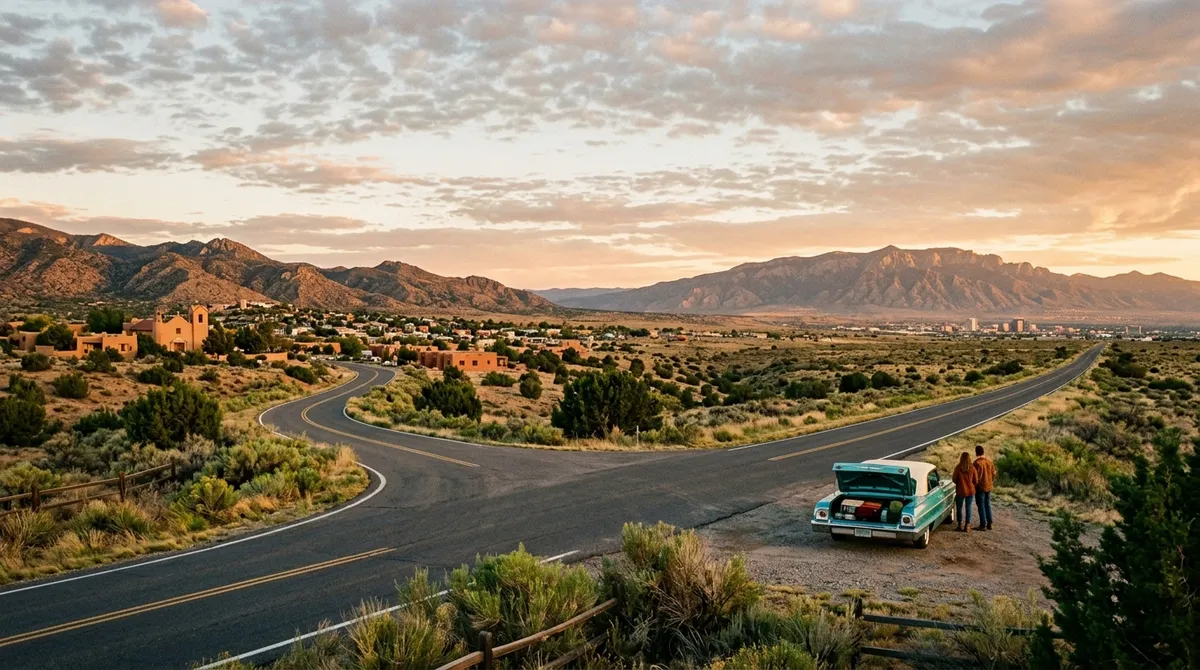
Here's a Route 66 fact most travelers don't know: the road has two alignments through New Mexico.
The original 1926 alignment swung north through Santa Fe in a big U-shaped detour. In 1937, the state straightened the road to go directly east-west through Albuquerque, cutting Santa Fe out entirely. Both routes are still drivable today, and the right answer is: drive both.
New Mexico is the most distinctive state on Route 66 — adobe everywhere, green chile on everything, mountains in every direction, and the best concentration of restored vintage motels on the entire route. Here's how to spend two days here.
Day One: Santa Fe (the 1926 Alignment)
Drive into New Mexico on the original 1926 alignment, north from Santa Rosa toward Las Vegas (New Mexico, not Nevada), then down into Santa Fe. The drive is empty, gorgeous, and rolling — high desert, pinyon pines, distant mountains.
Santa Fe itself is the oldest state capital in the U.S. (founded 1610) and the highest (7,199 feet). The whole downtown is built in Pueblo Revival style — flat-roofed, adobe-walled, rounded corners — and city ordinances keep new construction in the same style. The result is one of the most architecturally distinctive cities in America.
What to do:
Santa Fe Plaza. The historic center, walkable in 20 minutes. Native artisans sell jewelry along the north side under the Palace of the Governors portal — the oldest continuously occupied government building in the country (1610).
Loretto Chapel. Famous for its "miraculous staircase" — a spiral staircase with no central support and no nails, built by an anonymous carpenter in 1878.
Georgia O'Keeffe Museum. Small but excellent. O'Keeffe lived in northern New Mexico for decades and her landscapes are everywhere in her work.
Canyon Road. A half-mile stretch of art galleries — over 100 of them — in adobe buildings. Even if you're not buying, it's a great evening walk.
Eat: The Shed for red and green chile enchiladas (order "Christmas" to get both sauces). Tomasita's for the classic Santa Fe-style sopapillas. Geronimo for a splurge dinner.
Day Two: Albuquerque (the 1937 Alignment)
Drive south from Santa Fe to Albuquerque (about an hour). Once you hit Albuquerque, get on Central Avenue — that's old Route 66, and it runs east-west clear across the city.
Central Avenue in Albuquerque has the most concentrated stretch of vintage Route 66 motels still standing anywhere in America. Drive it slowly, from the Nob Hill neighborhood in the east, through the University District, through Downtown, and out west past Old Town.
Motels to look for (most are restored and still operating):
El Vado Motel. Built 1937, restored 2018, with a courtyard, taco shop, and the most photogenic neon sign on Route 66. If you're going to splurge on a motel night on this trip, do it here.
Monterey Motel. Still a working motel, original 1946 neon.
The De Anza Motor Lodge. Built 1939, now a mixed-use building, but the lobby and façade are preserved.
Route 66 Casino. Modern, but worth a coffee stop for the lobby — Route 66 memorabilia everywhere.
Old Town Albuquerque
The original 1706 Spanish town site, with a plaza, the San Felipe de Neri Church (1793), and a network of adobe shops and restaurants in a few square blocks. It's touristy but charming.
Eat at Church Street Cafe in Old Town — the building is a 1706 hacienda, and the green chile cheeseburger is one of the best in New Mexico.
The Sandia Peak Tramway
If you have a free afternoon in Albuquerque, take the Sandia Peak Tramway to the top of the Sandia Mountains. It's the longest aerial tramway in the Western Hemisphere — 2.7 miles — and the view from the top is one of the great views in the Southwest. Time it for sunset.
Green Chile, Explained
New Mexico is the only place in the world that grows authentic Hatch green chile — peppers from the Hatch Valley in southern New Mexico, harvested in late summer, roasted, and put on everything. It's not the same as Mexican green salsa. It's hotter, smokier, more vegetal. Try it on:
- Cheeseburgers (the iconic "green chile cheeseburger")
- Breakfast burritos (Albuquerque's perfect breakfast)
- Pizza (yes, this is a thing)
- Enchiladas (red or green or Christmas)
If you visit between August and October, you'll smell green chile roasting on every corner — the smoke is incredible, and you can buy a full bushel for cheap.
Where to Sleep
Santa Fe: La Fonda on the Plaza is the historic choice — Route 66 travelers stayed here in the 1930s, and the lobby is a museum of Southwestern art.
Albuquerque: El Vado Motel (mentioned above) is the dream Route 66 stay. Hotel Andaluz downtown is a beautifully restored historic hotel if you want luxury.
Practical Tips
Altitude is real. Santa Fe is over 7,000 feet, Albuquerque around 5,300. Drink way more water than feels necessary, especially day one. Hangovers at altitude are brutal.
Don't take the I-40 detour. Some Route 66 travelers skip Santa Fe to save time. Don't. The Santa Fe loop adds ~2 hours and is one of the trip's best stretches.
Acoma Sky City detour. About 60 miles west of Albuquerque, on a mesa, sits Acoma Pueblo — continuously inhabited since the 12th century, the oldest continuously inhabited city in the U.S. Tours run several times daily. A half-day side trip and one of the most extraordinary stops on Route 66.
Back to the Pillar
New Mexico is stop five of ten. The full route is here: Most People Drive Route 66 Wrong. These Are the 10 Stops That Matter.
Next stop: Petrified Forest National Park, Arizona — the only national park on Route 66.