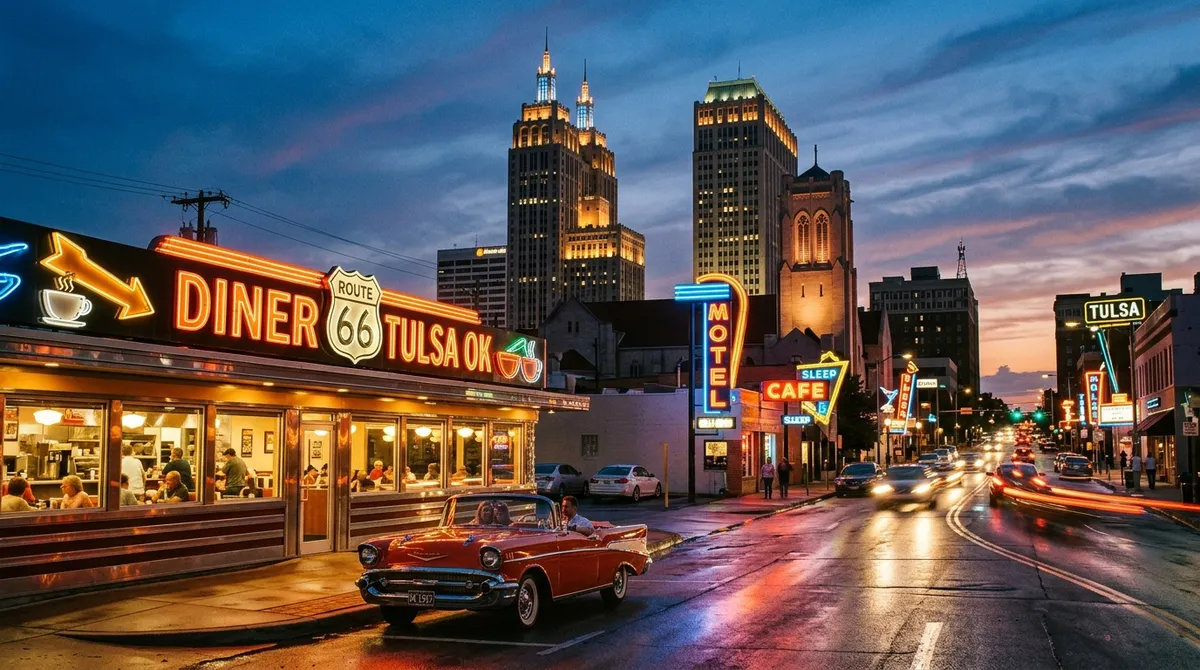
Ask most Route 66 travelers what they remember about Oklahoma and they'll mumble something about flatness, wind, and a few hours of nothing.
That's because they didn't stop in Tulsa. And not stopping in Tulsa is one of the biggest mistakes you can make on the Mother Road. This is the city that calls itself the "Birthplace of Route 66" — Cyrus Avery, the man who got the highway commissioned in 1926, lived here — and the downtown is a working museum of 1920s Art Deco architecture that rivals anything in Miami Beach. Plus the original Route 66 neon along 11th Street still lights up at night. Plus the food is incredible.
Here's why Tulsa is the underrated jewel of the trip.
The Art Deco Downtown
In the 1920s and 1930s, Tulsa was the "Oil Capital of the World," and the oil money built one of the most concentrated collections of Art Deco architecture in the country. Drive or walk a few square blocks downtown and you'll see it: the Boston Avenue Methodist Church (1929, one of the great Art Deco churches in America), the Philtower Building (1928, with its terra-cotta crown), the Tulsa Union Depot, and the Mid-Continent Tower.
The Tulsa Foundation for Architecture runs free Deco District walking tours on Saturdays, April through October. Even if you can't catch one, a self-guided wander downtown will blow you away.
The 11th Street Neon Stretch
For decades, Route 66 ran straight through Tulsa along 11th Street (also called Admiral Place east of downtown). Most of the original road signs are gone, but the neon has been restored, and at night the stretch from downtown east to about Yale Avenue lights up exactly like it did in 1955.
Drive it slowly after dark. Stops to look for:
Meadow Gold sign. A massive 1930s neon dairy sign that was rescued, restored, and re-erected on its own little park island in 2009. The corner of 11th and Quaker Avenue.
Tally's Café. Classic chrome-and-glass diner, open 24 hours, the best chicken-fried steak in town. The neon "Tally's" sign is one of the most photographed on Route 66.
Blue Dome District. A 1924 gas station turned bar district. The blue terracotta dome on the corner is the original gas station structure.
Cyrus Avery Plaza and the Route 66 Bridge
At the western edge of downtown, where Route 66 originally crossed the Arkansas River, you'll find Cyrus Avery Plaza — a small park with a striking bronze sculpture called "East Meets West." Avery, "The Father of Route 66," fought to get the highway routed through Tulsa in the 1920s, and the city built this plaza to honor him.
Walk across the Cyrus Avery Centennial Plaza Bridge (the new pedestrian bridge next to the old one) for a sense of how the road actually entered Tulsa. The plaza is best at sunset.
Where to Eat
Tulsa's food scene punches way above its weight. Beyond Tally's:
Hank's Hamburgers. Open since 1949. Order the "Big Okie" — a quadruple cheeseburger that requires both hands and lowered expectations of your evening.
Wilson's BBQ. Tulsa's best BBQ. Hot links, brisket, pulled pork. Tiny dining room, expect a wait.
Caz's Chowhouse. A blue-collar diner that does an outstanding Sunday brunch. Get the biscuits and gravy.
Where to Sleep
The Mayo Hotel. A 1925 Art Deco landmark, fully restored. JFK, Babe Ruth, and Charlie Chaplin all stayed here. The lobby alone is worth a visit even if you don't book a room.
Hotel Indigo Tulsa Downtown. Modern, hip, downtown, more affordable than the Mayo. Right in the middle of the Deco District.
Budget option: The Best Western Plus Downtown Tulsa Centre is clean, central, and well-priced.
Don't Skip the Golden Driller
On your way out of town, swing by the Golden Driller — a 76-foot, 43,500-pound statue of an oil worker on the Tulsa State Fairgrounds. It's the largest free-standing statue in the country and the official state monument of Oklahoma. Tacky? Absolutely. Worth the photo? Also absolutely.
Practical Tips
Plan for two nights if you can. One isn't enough to do the Deco District, the neon drive, and the BBQ properly. Two is comfortable.
Drive the 11th Street neon at sunset, not midnight. The lights are brightest and best photographed in the hour after sunset.
Watch for the Tulsa Race Massacre history. Tulsa's history isn't just neon and oil money. The 1921 Tulsa Race Massacre destroyed the Greenwood District, then the wealthiest Black neighborhood in America. The Greenwood Rising History Center is a sobering, important stop — one of the most powerful museums on the entire route.
Festivals to know. Tulsa hosts an annual Route 66 festival in early August. If your trip lands in that window, plan around it.
Back to the Pillar
Tulsa is stop three of ten. The full route is here: Most People Drive Route 66 Wrong. These Are the 10 Stops That Matter.
Next stop: Amarillo, Texas — home of Cadillac Ranch and the 72-ounce free steak.