
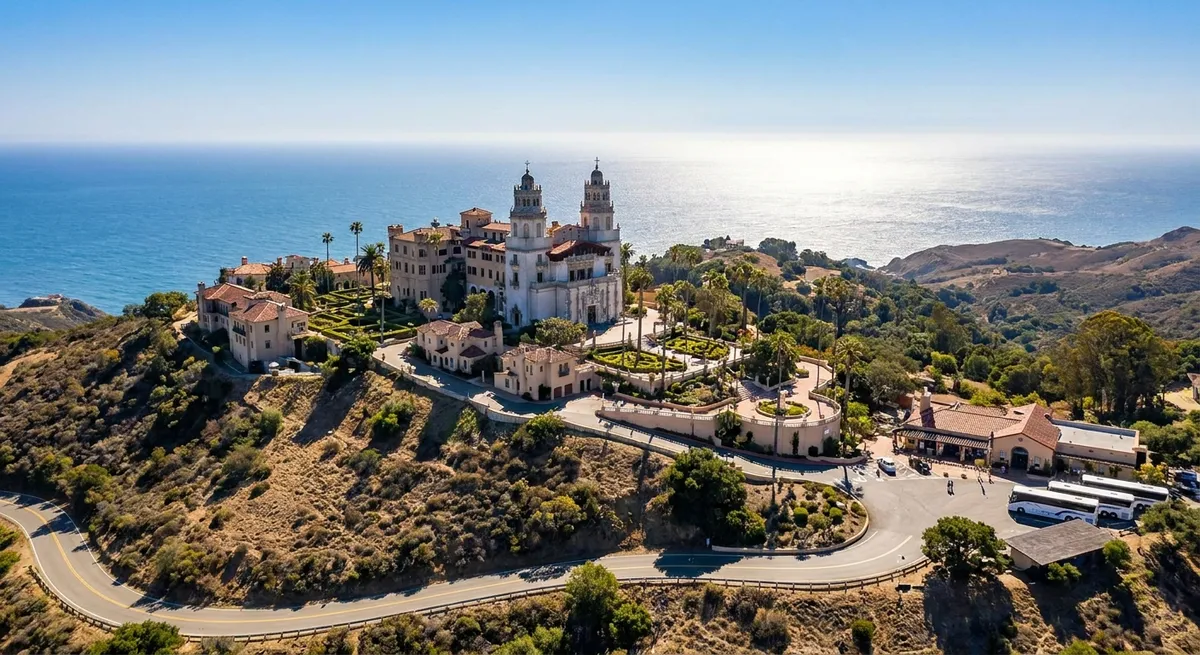
Hearst Castle is 250 rooms of opulence on a hillside overlooking the Pacific. It's absurd, extravagant, and one of the most dramatic buildings on the California coast. Here's what you actually need to know.
The Vision on "The Enchanted Hill"
Perched atop a hill in San Simeon, California, with commanding views of the Pacific Ocean, Hearst Castle stands as a monument to Gilded Age extravagance. Known to its creator as "La Cuesta Encantada" (The Enchanted Hill), this sprawling estate consists of a 165-room main house and three guesthouses, bringing the total to over 250 rooms spread across 127 acres of gardens, terraces, and pools.
The estate was the vision of one man: William Randolph Hearst, the enormously wealthy and powerful newspaper magnate. Having spent his childhood camping on the family's 250,000-acre ranch, Hearst envisioned creating a retreat that would rival the grandest palaces of Europe. In 1919, he famously told his architect, "Miss Morgan, we are tired of camping out in the open... I would like to build a little something."
The Architect: Julia Morgan
The architect tasked with realizing Hearst's ever-expanding dream was Julia Morgan, a pioneering figure in her field. As the first woman admitted to the prestigious architecture program at the École des Beaux-Arts in Paris and the first licensed female architect in California, Morgan was uniquely qualified. For nearly three decades, she dedicated herself to the project, overseeing every detail from structural engineering to the placement of priceless antiques.
Morgan’s collaboration with Hearst was a constant negotiation between his boundless imagination and the practical realities of construction. Her genius lay in her ability to translate Hearst’s often-vague desires into a cohesive, albeit fantastically eclectic, architectural masterpiece.
An Amalgam of European Styles
Hearst Castle is not defined by a single architectural style but is instead a lavish blend of Mediterranean Revival, Spanish Colonial, and other European influences. Hearst, an insatiable collector, imported entire rooms, ceilings, and thousands of works of art from European monasteries and castles to be integrated into the structure.
This approach is evident throughout the property. The grand Assembly Room features 16th-century Italian tapestries, while the Refectory boasts a 400-year-old carved wooden ceiling from a European monastery. The estate’s two famous pools—the outdoor Neptune Pool and the indoor Roman Pool, tiled with Venetian glass—further underscore the commitment to opulent, historicist design.
A Playground for Hollywood's Elite
During the 1920s and 1930s, Hearst Castle was one of the most exclusive social venues in the world. Hearst and his companion, actress Marion Davies, hosted a who's who of Hollywood royalty, political figures, and literary giants. Guests like Charlie Chaplin, Cary Grant, Greta Garbo, and Winston Churchill flew into the estate's private airfield for lavish parties and weekend retreats.
Life at the castle was a whirlwind of formal dinners, movie screenings in the private theater, and outdoor activities like tennis and horseback riding. The estate’s private zoo, which once housed exotic animals from around the world, added to the surreal and fantastical atmosphere.
From Private Estate to Public Landmark
Construction on the castle was a continuous process that halted in 1947 due to Hearst's declining health. While the estate was never fully completed to his ultimate vision, it stood as one of the most extravagant private residences ever built. The immense cost of maintenance, however, proved unsustainable for his heirs.
In 1957, the Hearst Corporation donated the castle and its immediate grounds to the State of California. It was opened to the public a year later as the Hearst San Simeon State Historical Monument, allowing future generations to witness the scale of Hearst's ambition and Morgan's architectural talent.
Visiting Hearst Castle Today
Today, Hearst Castle is one of California's most popular tourist destinations, attracting hundreds of thousands of visitors each year. A variety of guided tours offer glimpses into the opulent guest houses, the grand social rooms of the main building (Casa Grande), and the stunning gardens and pools.
For those interested in architecture, history, or the sheer spectacle of the Gilded Age, the castle provides an unparalleled look into a bygone era of American wealth and power. It remains a testament to a unique partnership between a patron with limitless funds and an architect of extraordinary skill. ```